

What Your Contractor Should Be Doing During Basement Excavation
Digging a basement looks straightforward from the outside: a machine, a pile of dirt, a hole in the ground. But what happens beneath the surface during excavation determines whether that basement holds up for a hundred years or becomes a chronic, costly problem. The difference isn't equipment. It's process.
According to the American Society of Civil Engineers, the majority of construction excavation incidents across the U.S. are process failures, not equipment failures. Knowing what a qualified contractor should be doing at every stage gives homeowners and developers a clear framework for evaluating bids, asking the right questions, and holding their crew accountable throughout the project.
Why the Excavation Phase Sets the Tone for Your Entire Project
When a homeowner or developer hires an excavation crew for a basement dig, they're trusting that team with one of the most structurally critical phases of the entire build. Get it wrong at this stage, and those problems follow the project all the way to the finished floor. Foundation cracks, chronic drainage issues, and failed inspections often trace directly back to something that went sideways during excavation.
A professional excavation contractor doesn't just show up and start digging. They follow a deliberate sequence of work that protects the structural integrity of the dig, the safety of the crew, and the schedule of every trade that follows them. Understanding that sequence makes it easier to spot who has done this before and who is figuring it out as they go.
The steps below outline what that process should look like, from the first day of planning through final sub-grade preparation.
Step 1: What Should Happen Before a Single Bucket of Dirt Moves?
Pre-Excavation Planning Is Not Optional
A thorough site assessment is how professionals avoid the kind of expensive surprises that derail projects and blow budgets. Before excavation begins, a competent contractor should evaluate soil composition, drainage patterns, proximity to existing structures, and the location of underground utilities. These aren't bonus services. They're baseline expectations.
In Delaware, contractors are required to contact Miss Utility before any digging begins. That's the state's 811 service, which marks underground utility lines including gas, electric, water, and telecommunications. Miss Utility typically requires 72 hours of advance notice, and this step is not optional. Any contractor who skips it is creating serious liability for the property owner.
What Does a Soil Assessment Actually Tell You?
Soil testing reveals whether the ground contains fill material, organic layers, or high clay content. All of those factors affect how excavation walls will behave and what support measures will be needed before work begins. A professional crew will also note which direction water naturally flows across the property, because basement excavations that ignore drainage often become basement flooding problems years down the line.
If a contractor shows up to bid without asking about soil conditions or drainage patterns, that's a conversation worth having before any equipment is mobilized. Site-specific knowledge at this stage isn't just helpful. It's the difference between a dig that goes smoothly and one that stalls mid-project.

Step 2: Getting the Dimensions Right
How Deep and Wide Should a Basement Excavation Be?
Getting the dimensions right isn't just about fitting the foundation. A well-executed basement excavation requires additional working space beyond the foundation footprint itself, typically a minimum of 2 to 3 feet on each side. That buffer allows room for formwork, waterproofing application, and drain tile installation. Contractors who dig to the exact foundation footprint often create problems for every trade that follows.
For most residential full basements in this region, excavation depth runs between 8 and 10 feet below finished grade. That figure accounts for the concrete slab, the aggregate base, and any drainage systems installed beneath it. The contractor should be working from engineered drawings or a surveyor's grade stakes, not estimating by eye.
Why Precision at This Stage Protects Every Trade That Follows
An uneven or over-excavated floor creates additional labor and material costs when the foundation contractor has to compensate for inconsistencies in the sub-grade. Experienced excavators understand they're setting the stage for every trade behind them, and they take that responsibility seriously.
If someone shows up to a basement dig without a set of plans or elevation benchmarks, that's a red flag worth addressing before the machine starts running. Precision at the excavation stage isn't about being meticulous for its own sake. It's about not creating problems that cost three times as much to fix as they would have cost to prevent.

Step 3: Managing Excavation Walls to Prevent Collapse
What Does OSHA Require for Excavations Deeper Than 5 Feet?
Excavation wall failure is one of the leading causes of construction fatalities in the United States. OSHA has specific requirements governing how excavations deeper than 5 feet must be handled: contractors must either slope the walls, use a trench box, or shore up the walls to prevent collapse. For a typical basement dig in the 8 to 10-foot range, there is no flexibility here.
The method used depends largely on soil type. In Delaware's coastal plain soils, which are often sandy or silty in nature, the angle of repose is lower than in harder, more cohesive soils. Sandy soils require a shallower slope angle, sometimes as gradual as 1.5:1 horizontal to vertical. A contractor who doesn't discuss soil classification and sloping requirements upfront likely hasn't thought carefully through this phase.
Do Adjacent Structures Change the Excavation Approach?
Yes, significantly. Existing foundations, retaining walls, or neighboring buildings create additional complexity for any deep excavation. Digging close to an existing structure may require underpinning or phased digging techniques to avoid undermining that structure's footing.
Identifying these site conditions before mobilizing equipment avoids the scenario where a complication surfaces mid-project, when options are fewer and costs are higher. That kind of upfront evaluation is what separates contractors who plan well from those who react to problems after they've already occurred.

Step 4: Managing Soil Removal and Keeping the Site Organized
How Much Soil Does a Basement Excavation Actually Move?
Excavated soil doesn't disappear, and a professional contractor will have a plan for it before work begins. For a standard residential basement, excavators might move anywhere from 150 to 400 cubic yards of material depending on the footprint and depth. That translates to a significant volume of truck traffic and off-site coordination.
A good contractor communicates this upfront: how many loads, which disposal site they use, and whether any material can be retained on-site for final grading. Stockpiling soil on-site can be useful, but placement matters. Spoil piles positioned too close to the excavation edge add surcharge load to the walls, which increases collapse risk.
OSHA guidelines recommend keeping spoil piles at least 2 feet from the edge of an excavation as a minimum, and farther in soft or saturated soils. That buffer isn't just a regulatory requirement. It's basic site safety.
What Does Good Site Management Look Like During a Dig?
Site organization reflects a crew's overall professionalism. Sloppy staging, equipment blocking access routes, and spoils dumped haphazardly across the yard are signs that the team isn't thinking through the full scope of work. The excavation phase sets the tone for the entire project, and organized contractors tend to run tighter jobs from start to finish.
The site should also be managed to prevent stormwater runoff from entering the open excavation. Runoff can destabilize walls and create dewatering problems that delay concrete work and drive up project costs.
Step 5: Sub-Grade Preparation and Drainage Rough-In
What Needs to Happen After the Hole Is Dug?
Reaching target depth doesn't mean the excavation work is done. Proper sub-grade preparation is essential before any concrete or foundation work can begin. The bottom of the excavation should be compacted and graded to a consistent elevation.
Soft spots, areas with organic material, or zones where the excavator dug too deep need to be addressed with engineered fill, compacted in lifts. Covering them over without corrective action is how structural problems develop quietly over time, only becoming obvious after the foundation is poured and the walls are up.
When Should Drain Tile and Drainage Systems Be Installed?
Drainage rough-in typically happens at this stage. Interior perimeter drain tile systems, the kind that collect groundwater and route it to a sump pit, are installed at or near the footing level before the foundation walls go up. A good excavation contractor understands the sequencing here and communicates with the foundation or waterproofing contractor to ensure those systems are installed before backfill covers them permanently.
In areas with high water tables or poorly drained soils, contractors may also need to actively dewater the excavation during the dig using sump pumps or well points. Any contractor who dismisses water in the excavation as a non-issue during footing work deserves a harder follow-up question before work proceeds.

How to Evaluate a Basement Excavation Contractor in Delaware
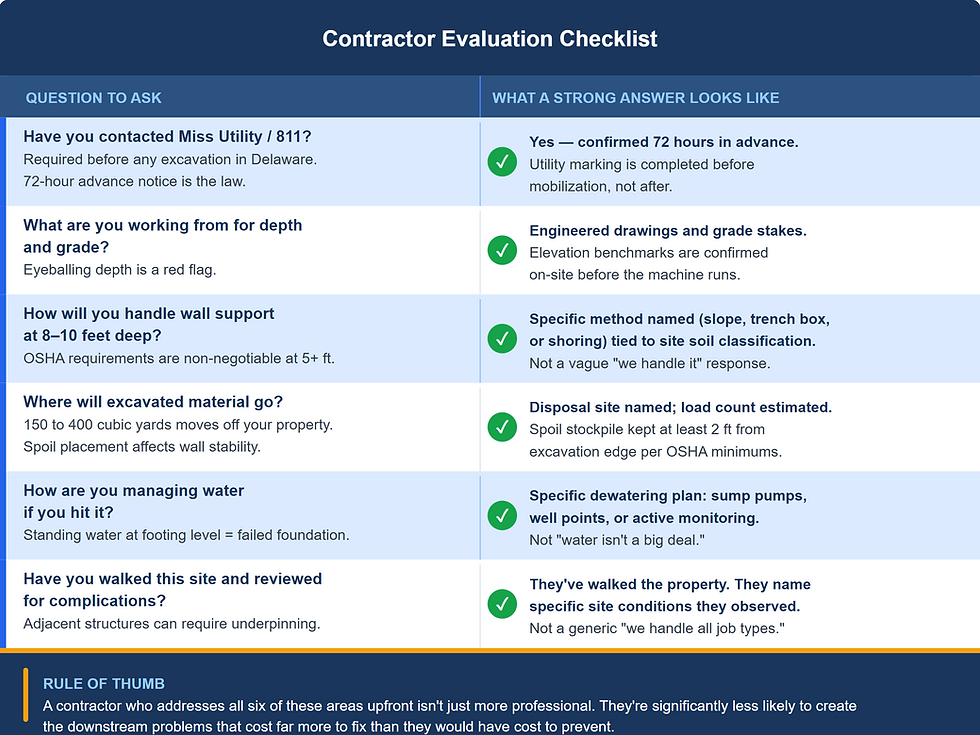
Evaluating excavation contractors comes down to one question: do they demonstrate site-specific knowledge, or just equipment availability? The right contractor will walk the site, review plans, discuss soil conditions, and lay out a clear sequence of work before they ever mobilize a machine. That level of preparation is what separates a professional excavation company from someone who is skilled at operating equipment but hasn't accounted for what comes next.
When comparing bids, look for contractors who address utility marking, soil classification, wall support method, drainage coordination, and spoil removal as part of their standard proposal. Vague answers to any of these questions are worth probing before signing a contract.
Red Flags to Watch For Before Work Begins
No mention of Miss Utility or 811 contact before mobilization
No engineered drawings or grade benchmarks on-site
No discussion of soil type or sloping requirements
Spoil pile placed at or near the edge of the excavation
Dismissive response to questions about water or adjacent structures
A contractor who addresses every one of these areas isn't just more professional. They're significantly less likely to create the kind of downstream problems that cost far more to fix than they would have cost to prevent.
The Bottom Line: Details Underground Determine Everything Above
Basement excavation is one of those phases that looks deceptively simple from the outside. A big machine, a pile of dirt, a hole in the ground. But the details, including utility marking, soil classification, wall support, drainage planning, and sub-grade preparation, determine whether that basement serves the building for a hundred years or becomes a chronic problem within a decade.
Homeowners and developers who understand what their contractor should be doing at each stage are in a much stronger position to evaluate bids, ask the right questions, and hold their crew accountable. Look for crews who demonstrate site-specific knowledge before they demonstrate what equipment they run. That's the standard worth holding.


Comments